
Fraud Intelligence Guide
Card Testing Detection: Signals Before Checkout
Follow the attempts, not just the completed orders.
By Michael Joseph · Last updated: October 23, 2026
What to understand
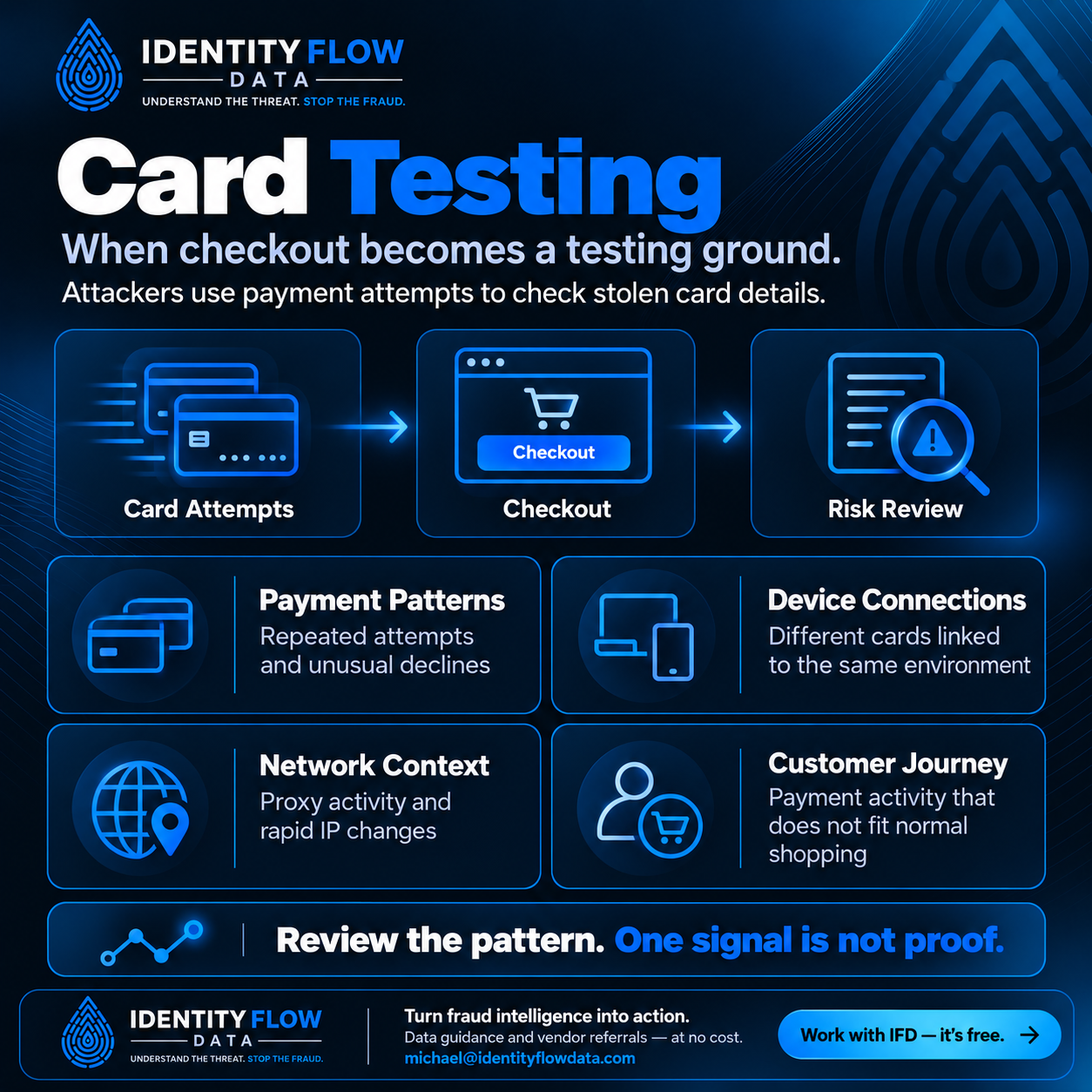
Card testing uses payment attempts to assess whether compromised card details can be used. The merchant may see repeated declines, changing payment details or a burst of activity with little genuine shopping. A successful purchase is not required for the activity to consume resources or reveal useful information to an attacker.
Connect the payment sequence
Compare attempts within a session and across related sessions. Review when payment details change, whether the same environment appears with different cards, and whether the journey includes ordinary browsing and purchasing behavior. Keep processor responses with the earlier account and device context so reviewers can reconstruct what happened.
Signals to review together
With card testing, the goal is to find out which stolen card details still work.
- Payment Patterns: Repeated attempts and unusual declines
- Device Connections: Different cards linked to the same environment
- Network Context: Proxy activity and rapid IP changes
- Customer Journey: Payment activity that does not fit normal shopping
Evaluate decisions at the right moment
Separate attempts that were blocked, challenged, approved or abandoned. Compare confirmed abusive activity with legitimate customers who retried after a decline. Measure whether added signals improve review decisions before payment, as well as their effect on customer completion.
Keep legitimate activity in view
A decline alone does not prove fraud. Neither does a VPN or a customer trying another card.
How IFD can help
Tell us which decision you want to improve and what evidence your team already has. IFD helps clarify useful signals, compare suitable providers and scope an evaluation. We review coverage, limitations and practical fit so your team can decide on the next step.
Common questions
Choose your starting point with IFD.
Evaluate your fraud data
Discuss a sample evaluation of relevant fraud and identity signals. No IFD coordination fee; scope and any provider charges agreed first.
Request a Data EvaluationUnderstand your business’s exposure
Request a scoped review of relevant underground activity and fraud techniques involving your business. No customer dataset required.
Request a Free Exposure ScanThere is no advisory fee for buyers. IFD is compensated by participating providers when a qualifying purchase results from a referral. We explain applicable arrangements upfront. Any provider testing or product charges are confirmed before you proceed.