
Fraud Intelligence Guide
Location Manipulation and Geographic Access Risk
Understand what each location signal can establish.
By Michael Joseph · Last updated: October 23, 2026
What to understand
A claimed address, an IP-based estimate and a device location are different kinds of evidence. Disagreement may reflect manipulation, but it can also come from travel, network routing, permissions or data limitations. A useful review begins with the actual access policy and the evidence needed to apply it fairly.
Compare signals without treating estimates as certainty
Document the source, time and precision of each location observation. Review changes alongside device and account history. Where a policy restricts access by geography, decide how ambiguous cases will be handled rather than assuming a VPN proves the user is outside an allowed area.
Signals to review together
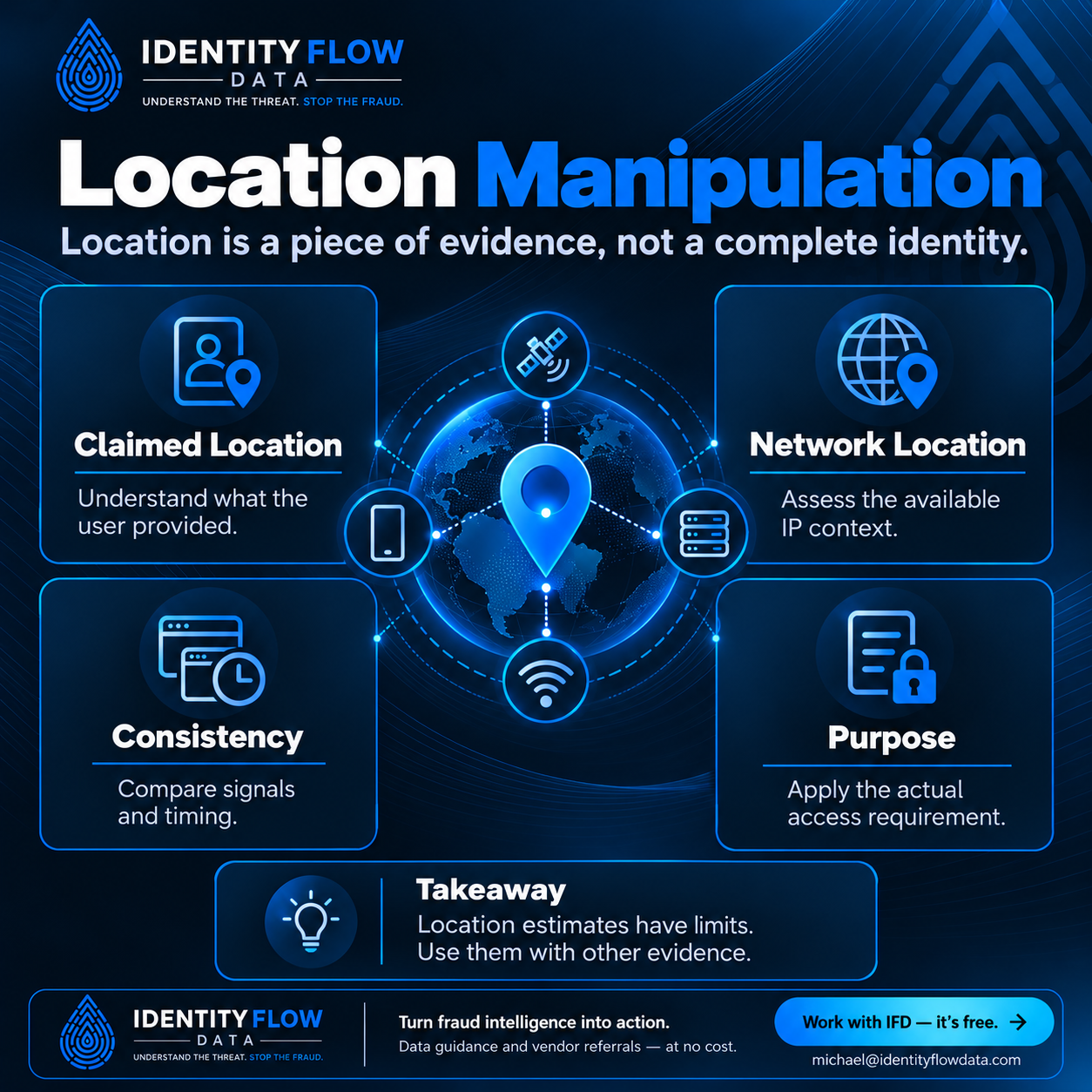
Disguised or inconsistent location signals can affect access and account decisions, but ordinary travel and network routing can create changes too.
- Claimed Location: Understand what the user provided
- Network Location: Assess the available IP context
- Consistency: Compare signals and timing
- Purpose: Apply the actual access requirement
Evaluate geographic restriction evasion
Assess repeated attempts to access a restricted service in the context of the account journey. Consider legitimate travel and authorized users who rely on privacy tools. Compare escalation outcomes and customer support cases when evaluating a provider; a higher detection count alone does not establish better policy enforcement.
Geographic Restriction Evasion
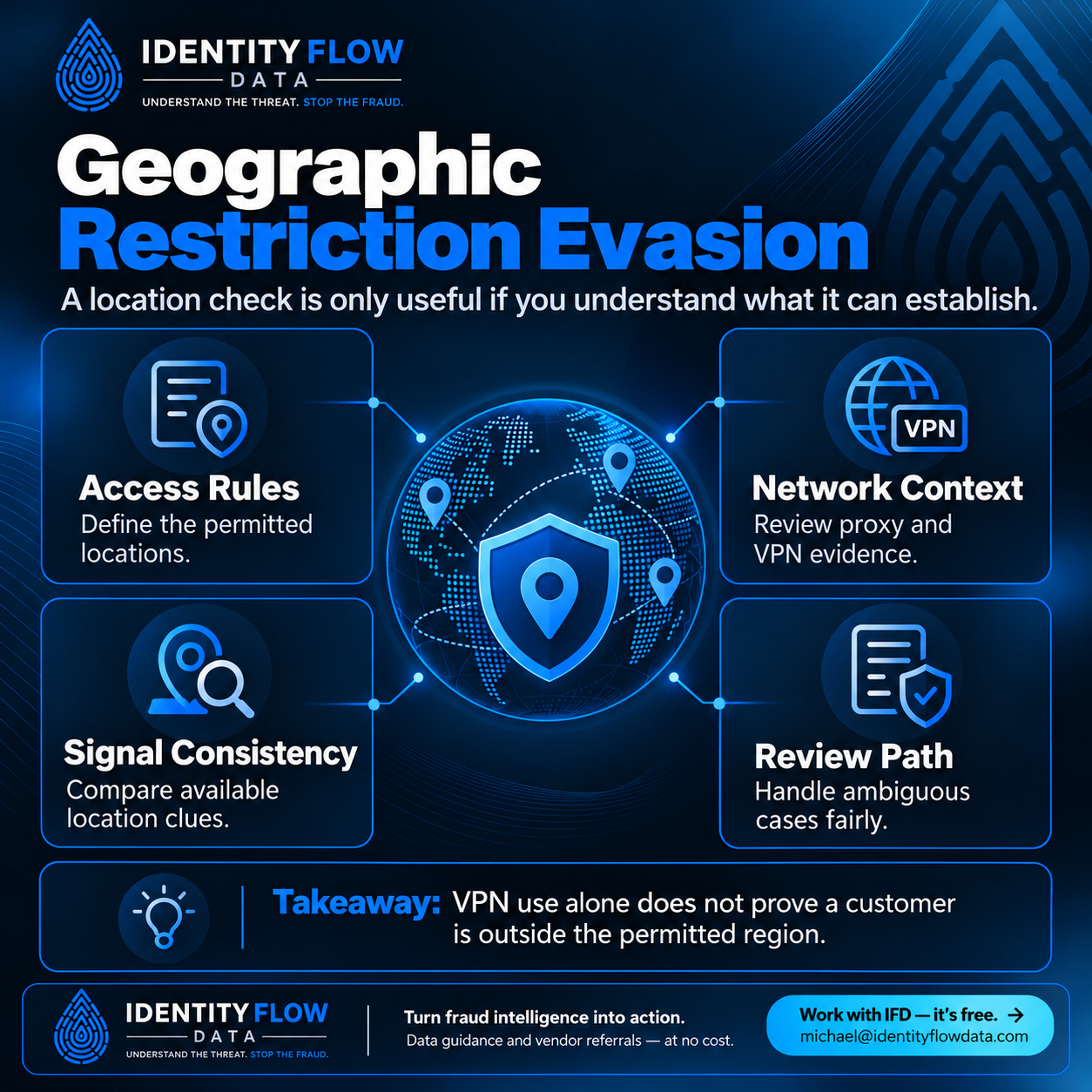
Services with geographic access rules may face users attempting to disguise where a session originates.
- Access Rules: Define the permitted locations
- Network Context: Review proxy and VPN evidence
- Signal Consistency: Compare available location clues
- Review Path: Handle ambiguous cases fairly
Keep legitimate activity in view
Location estimates have limits. Use them with other evidence.
How IFD can help
Tell us which decision you want to improve and what evidence your team already has. IFD helps clarify useful signals, compare suitable providers and scope an evaluation. We review coverage, limitations and practical fit so your team can decide on the next step.
Common questions
Choose your starting point with IFD.
Understand your business’s exposure
Request a scoped review of relevant underground activity and fraud techniques involving your business. No customer dataset required.
Request a Free Exposure ScanEvaluate your fraud data
Discuss a sample evaluation of relevant fraud and identity signals. No IFD coordination fee; scope and any provider charges agreed first.
Request a Data EvaluationThere is no advisory fee for buyers. IFD is compensated by participating providers when a qualifying purchase results from a referral. We explain applicable arrangements upfront. Any provider testing or product charges are confirmed before you proceed.
Related guidance